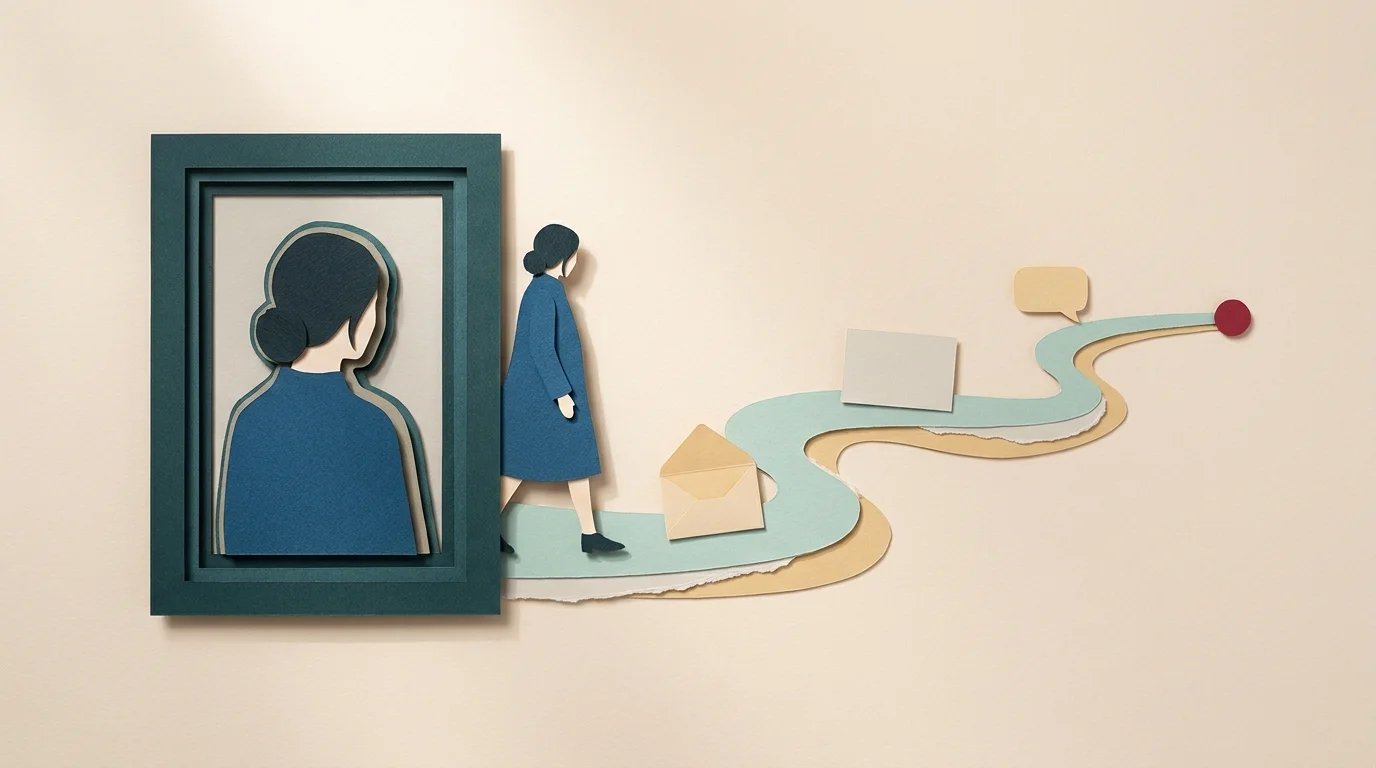
A persona deck is one of the most satisfying things you can hand a client. Names, faces, a tidy quote, a day in the life. Everyone around the table nods. And then, more often than I'd like to admit, it goes in a drawer — and three months later nobody can point to a single decision it changed.
I've built these decks. I've also watched a lot of them quietly die. The pattern is almost always the same: the persona describes who the customer is, and then the work stops — right at the moment it was about to become useful. A persona is a description. And a description, on its own, has never once changed how a customer behaves. An experience does that. The gap between the two is where a surprising amount of brand strategy falls apart.
This isn't an argument against personas. We develop them with nearly every client partner, and I've written before about how to design and validate them. It's an argument against stopping there. The persona is the first draft of an experience, not the finished product — and treating it as the finish line is what leaves you with a beautiful artifact and a strategy that doesn't survive contact with a real customer.
A Persona Is a Noun. An Experience Is a Verb.
Here's the distinction I keep coming back to. A persona is a noun. It describes a person who exists whether or not you ever do anything: "Maria, 34, VP of Operations, protective of her time, allergic to clunky software." Every word of that can be true and still move nothing. It's a portrait. You can hang it on the wall.
An experience is a verb. It's the sequence of things that actually happen to Maria — the email she opens at 9pm, the signup form she abandons on the fourth field, the support reply that either wins her back or confirms she was right to leave. Behavior lives in the verbs. "Maria values her time" isn't something you can act on. "Maria abandons any onboarding longer than two minutes" is. One is a description; the other is a decision waiting to happen.
Experience Is Where Customers Actually Decide
If you want evidence that the experience is the real battleground, the research has gotten hard to ignore. In Salesforce's State of the Connected Customer survey — close to 17,000 people — 88% now say the experience a company provides matters as much as its products and services. PwC, in its Experience Is Everything study of 15,000 consumers, found that one in three will walk away from a brand they love after a single bad experience, and that people will pay as much as a 16% premium for a better one. Not one person in either study was reacting to a persona. They were reacting to what happened to them.
You've got to start with the customer experience and work backwards to the technology.
Steve Jobs
And it's the whole experience that counts, not the individual moments. McKinsey's research comparing journeys to touchpoints found that how a company performs across an entire journey is far more tightly linked to revenue, churn, and repeat purchase than how it performs at any single touchpoint — in health insurance, customers were 73% more likely to be satisfied when the full journey worked than when the separate touchpoints did. A great support reply can't rescue a broken onboarding. The journey is the unit that matters, and a persona only earns its keep when it's pointed at one.
Where the Bridge Collapses
So why does the persona so reliably stall at the description stage? Usually it's structural, not lazy. Brand strategy tends to end at the deck — that's the deliverable, that's where the engagement wraps, that's where the applause happens. But the experience lives somewhere else entirely: in product, in onboarding, in the lifecycle emails, in how support answers at 9pm. Different teams. Different budgets. Often a different quarter, after the brand work is "done" and everyone has moved on.
So the persona never gets translated into a decision rule. It informs the launch — the homepage, the pitch, the first campaign — and then the launch ends, and there's nothing connecting Maria to what she encounters in week six. That's why so much strategy looks great on day one and stops working by the end of the quarter. The part that would have carried it forward was the part nobody built.

How to Build the Bridge
Closing the gap isn't a second project. It's a handful of moves that turn each persona from a portrait into something an experience can actually inherit from.
- Rewrite every trait as a behavior. "Values efficiency" is a fact you can file and forget. "Will abandon a twelve-field signup" is a prediction you can design against — and test. For each line in the persona, write the behavior it implies. If you can't, the trait probably isn't doing any work.
- Put the persona in its real moments. A persona without a journey is a portrait without a story. Drop Maria into the actual sequence — first touch, evaluation, the messy middle of onboarding, the quiet renewal months later — and decide what should happen at each stop. People aren't a demographic; they're a person in a moment trying to finish a job.
- Resolve adjectives into decisions. "Maria values her time" has to become a specific call someone can ship: cut onboarding to one screen, default the plan most people pick, kill the welcome email that adds nothing. Adjectives describe. Decisions change the experience. If the persona never forces a decision, it never reaches the customer.
- Pick the one behavior that proves you were right. Every persona makes a falsifiable claim about how someone will act. Instrument it — activation rate, time to first value, the reply rate on the apology email. If the number moves, the persona was real. If it doesn't, it was a guess, and now you know, which is its own kind of win.
- Feed the behavior back. The journey tells you things the deck never could. McKinsey's whole point — that the full journey predicts revenue and retention far better than any single touchpoint — only pays off if you keep watching the journey and revising the persona to match what people actually do, not what you assumed they'd do.
The Strategy That Survives the Quarter
The brands still standing a quarter after launch aren't the ones with the best-looking personas. They're the ones who treated the persona as the opening move of an experience and built the rest of the board. They turned "who is this person" into "what happens to this person, and how do we know it's working."
Personas describe people. Experiences change behavior. The bridge between them — built on purpose, with a real metric waiting on the other side — is the part of the work that compounds. It's also the part most likely to get skipped, which means doing it is one of the quieter ways a brand pulls ahead of the ones that stopped at the deck.